
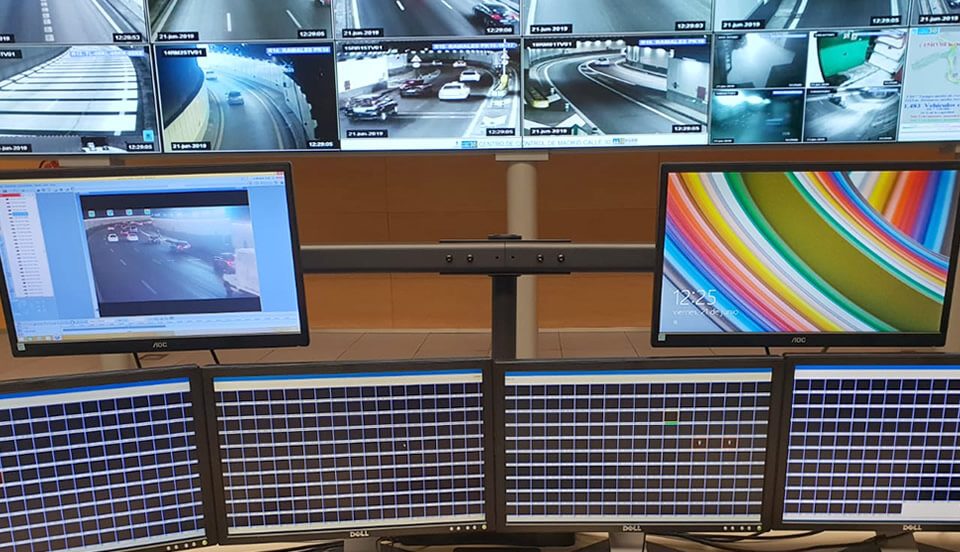

The Automatic Incident Detection System on the M30 helps detect when an accident has occurred in real time.Meaning that it is a traffic control system that enables the automatic detection of accidents.Video recording allows the operator to broaden the scene of the event and, depending on the type of incident, activate the corresponding action protocol .
Operation of the Automatic Incident Detection System on the M-30
This system makes it possible to ensure the safety and fluidity of traffic, since it allows immediate sight of the incident and the appropriate action can be taken.There is only a 3 second delay with the transmitted video images, so it enables immediate action to be taken avoiding any further consequences.
What happens when there is an accident?
Among others, the system detects the following incidents:
- Stationary vehicles that have stopped or are facing the opposite direction
- The presence of a pedestrian on the road
- Vehicle congestion
- Vehicles circulating at a slower rate than recommended
- Vehicle collision
- Objects on the road
After understanding and assessing the gravity of the incident, the M30 intervention units act immediately.Along the route there are four different bases (Méndez Álvaro, Paseo de Extremadura, Vicente Calderón and the Valencia Highway).The base unit closest to the incident moves to start solving the problem.
How is the Automatic Incident Detection System activated?
In two ways:
- The system alerts the operator that there is no continuous traffic in an area or that it is moving in the opposite direction by letting off a visual and audible warning.It also warns of any strange presences or irregularities of the conditions listed above.
- Human Activation.Anybody driving on the M30 can call the emergency services from their mobile phone to ask for help.If preferred, one can use one of the SOS posts that are installed in the tunnels every 75 meters.If this is the case, the first response teams have defibrillators in their vehicles.The teams have received specific training fo their management and the instructions are in the team itself, being very intuitive.Not surprisingly, the M30 has the first cardioprotected tunnels in the world.
It is important to remember that if evacuation is recommended, it would take place in the following way:
- In the South ByPass, there are depths of up to 60 meters.The evacuation is done through the emergency gallery located under the road opposite to where the emergency has taken place.The evacuation route is appropriately indicated both on the road and inside the emergency exit.
- With a maximum depth of 16 meters, the tunnels parallel to the Manzanares and on the Avenida de Portugal, have an evacuation route towards Madrid Río.Likewise, the evacuation route is marked both on the road and inside the emergency exit.In the event of an evacuation the user firstly has to go to the nearest emergency exit and from there follow the evacuation signs.
As you can see, the M30’s automatic accident detection system is a safeguard for all drivers and pedestrians.Having the certainty that any anomaly will be solved in the shortest possible time allows you to always drive more calmly.Thus, the M30 has become one of the safest roads in Europe thanks to the huge investment in security systems.
Related reading