
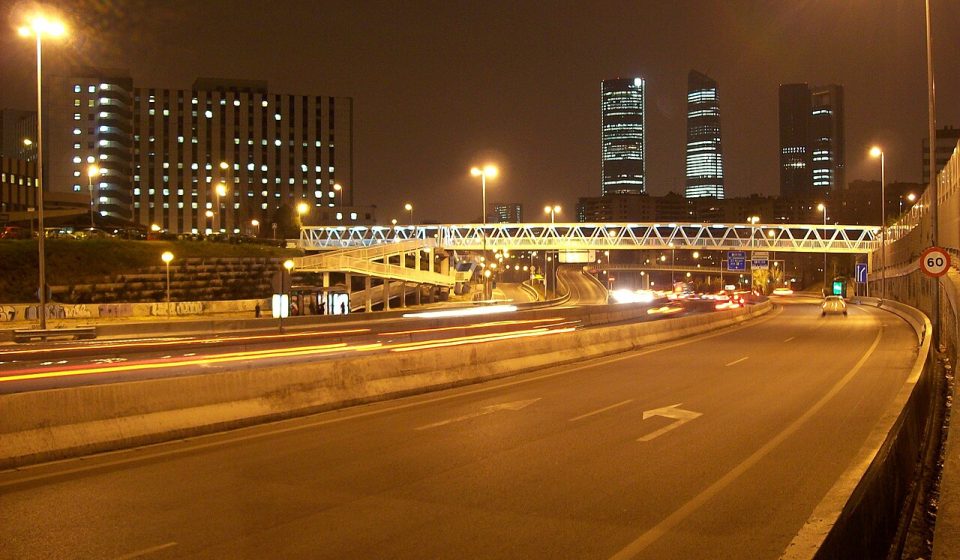

Graffitis on the M30 are growing increasingly prevalent. Seeing walls and other infrastructure covered in paint is very common but what does this activity entail? What are the harmful effects of graffiti? What is the environmental impact? How are they cleaned up? In this post we tell you everything you need to know about the negative effect of graffiti, an activity which leads to fines for those committing the offence.
Graffitis on the M-30 strategy
Graffitiing has damaging consequences and a serious environmental impact as a result of the aerosol cans used which damage materials and create pollution. They are also an eyesore that can be seen throughout the city. That’s why we carry out regular campaigns on the M-30 to remove graffiti from walls and other infrastructure.
This requires cleaning, repainting to cover the damage, and applying insulated cork to treat, waterproof, and cover the material to prevent unnecessary toxic residues dispersing.
Last year, a total of 1,850kg of paint in 74 25kg paint cans was used. The total surface area repainted was 13,215 square meters. The most innovative approach used was the application of insulated cork. What does this involve?
Insulated cork is a material made from organic pigments, resin, and ground natural cork. This makes it an environmentally friendly material whose main component, cork, comes from the renewable source of the natural cork trees of the Iberian Peninsula. Using it provides unbeatable acoustic and thermal insulation, waterproofing that also allows the materials under it to breath, and a protective film that protects the structures it is applied to. This also helps to protect structures from inclement weather, such as rain and wind, and ensures structural integrity.
Coloured hearts on the M-30
Graffitiing is very common. It is also an act of vandalism. The reason behind the graffiti, the drawing, the colours, the lines, and so on does not matter. In Madrid, on the M-30 specifically, someone spent a great deal of time drawing coloured hearts. The first ones were red, and then others of different colours were added. The author is still unknown.
LWhat we do know is that after the arrest of the first graffiti artist to be arrested in Madrid, she was said to be behind the coloured hearts on the M30 as she signed her Graffiti under the pseudonym of “Love”. However, after a letter was sent to various newspapers in the capital refuting that she was responsible for the appearance of the hearts in Madrid, the true identity of the person behind the drawings on the M-30 remains unknown. Whoever it may be, the fact remains that graffiti is damaging for the image of the city and is a source of pollution.
To conclude, Emesa follows a cleaning and reconditioning plan for walls and other structures to keep the motorways looking clean and protect public assets from climate change. Please remember that there are areas which are specifically earmarked for graffiti as art and for people to express their creativity. But doing so on streets, walls, and other public spaces is not a good idea and has consequences both for the environment and the person graffitiing.
Related reading
Photo: Luis García (Zaqarbal), CC BY-SA 3.0, via Wikimedia Commons