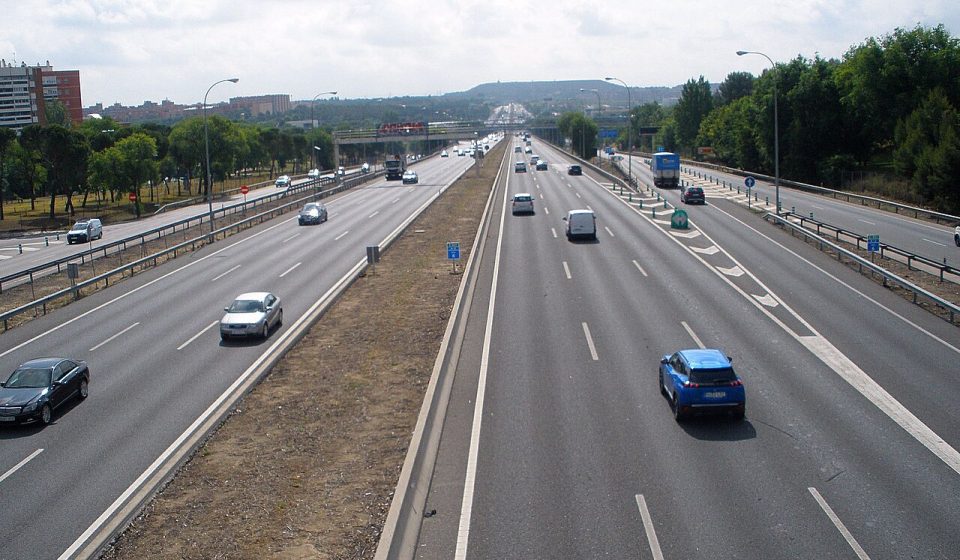

Many ask why the most important ring road in the city of Madrid is called M-30. There is without a doubt a much more interesting story behind this name than you would imagine. Here it is, explained in detail.
Do you know why the M-30 has this name? Historical events
Of course, the city of Madrid has not always looked like it does today. In fact, it has gone through numerous expansions over the years due to the relentless growth in population as well as the area used for development.
The first ring road
It was in 1857 through the publication of a Royal Decree that Queen Isabel II authorised Claudio Moyano, Minister of Public Works at the time, to develop the Madrid Expansion Project. Moyano put the engineer and architect Carlos María de Castro in charge. From then on it was popularly known as the ‘Castro Plan’.
The project created a first ring road which aimed to delimit the city. It was given the name M10 and the route passed mainly through Bulevares, Princesa, Colón, Recoletos, Gran Vía and Alcalá.
The second ring road
Meanwhile, as part of the same plan another large ring road was established which included other urban areas. This was officially called Paseo de Ronda. However, it ended up being better known as M20. The route ran through the streets Raimundo Fernández Villaverde, Doctor Esquerdo, Pedro Bosch, Joaquín Costa and Francisco Silvela.
The need for a new ring road
Not 50 years had passed when the need to create a third ring road was identified, due to the growth that the city of Madrid had undergone. However, it was not until 1929 when planning began.
The Zuazo-Jansen Plan
In 1929 the Madrid Preliminary Road Layout and Urban Planning Project was approved, which is better known as the Zuazo-Jansen Plan. This project talked about a third ring road for the capital city for the first time, in other words the M-30.
It was not until 1946, however, that it was finally approved in the Madrid General Urban Development Plan, also know as the Bigador Plan. In fact, it even envisaged a fourth ring road. But incredibly, it was not until the start of the 1970s that construction was begun.
So why is it named M-30?
In addition to the story we have already related, we have to go back to 1939 when the Peña Plan was approved to find the origin of the road’s name. This plan set the guidelines for the naming of each and every road in Spain.
Firstly, M is used as it is the first letter of Madrid. It must be noted that there are other Spanish cities such as Malaga that also begin with ‘M’. However, since it is the capital city it is given priority.
The use of the number 3 relates to the aforementioned story, and simply means that it is the third ring road in the city. The 0 simply refers to the fact that it is a ring road, as determined by the Peña Plan. Together, these points give us the name M30.
You only need to look at a map of the city of Madrid and check where each of the three ring roads are to see the expansion that the city has undergone. The story behind the naming of the M-30 certainly helps provide an overview of a process which has taken place over a 150-year period.
Photo: Zarateman, CC0, via Wikimedia Commons