
How the M-30 is cleaned is one of the questions raised by the citizens of Madrid. How it is cleaned depends on what exactly is being cleaned. Therefore, footpaths and islands, roads and hard shoulders or safety elements each follow a different protocol.
The coordination of cleaning tasks is essential and, in addition, they are carried out in a way that affects traffic as little as possible. That is why citizens often ask when, how often and how the M-30 is cleaned.
Furthermore, different cleaning equipment is used. The M-30 cleaning process is increasingly committed to improving energy management and reducing waste that endangers the environment. For some time now, Emesa has been following the circular economy while cleaning this road.
How is the M-30 cleaned?
Although the frequency with which cleaning tasks are carried out depends on what part is being cleaned, most of the tasks are performed monthly. For accidents or spills, action is taken immediately, with average arrival times of 5 minutes.
For cleaning, recycled water is used in all cases. However, if the discharge of substances cannot be cleaned perfectly with water, degreasers or other products such as sepiolite may be used.
Cleaning footpaths and islands
In addition to periodically sweeping these areas, Emesa collects the different residues that are found, replaces any defective parts, and prunes and removes vegetation that may invade the road space. Furthermore, salt treatments are carried out on footpaths to prevent frost in winter.
Cleaning roads and hard shoulders
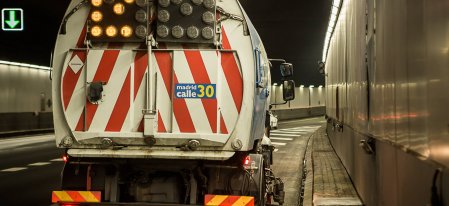
Roads and hard shoulders are cleaned using all types of sweepers and always with the latest technology. In total, more than ten mechanical sweepers, vacuum cleaners and trucks are used for all types of surfaces.
In fact, the machinery varies depending on whether it is intended for cleaning large areas or links and road branches. In addition, water flushing trucks are used for cleaning up spills.
All the machinery used to clean these roads has a GPS tracking as well as light signals. This allows them to be visible from afar and located at all times.
Cleaning safety elements
The road safety elements help to make out the road and detect areas of greater danger from afar. Therefore, these objects need to be cleaned regularly in order for them to be highly visible. In addition, in case of irreparable damage, the replacement thereof is very simple.
Cleaning roadsides
More than 800,000 kilos of waste is left on roadsides every month. To clean them, the teams walk along the different sections on foot, getting rid of paper, plastics and packaging.
M-30 cleaning equipment
As we have seen, the cleaning equipment used on the M-30 is varied and meets the needs of each of the road´s areas. Although there are several types of each, they can be divided mainly into sweepers and water flushing trucks, as explained below.
Mechanical sweeper
This machine has a series of brushes and suction, which enable the dirt present on the road to be removed. It is used primarily for removing solid waste as well as for leaf or branch debris.
Street cleaning machine
The water flushing truck is a tank truck that uses pressurised water to remove dirt present on the road. In this case, the flusher is used to get rid of liquid spills such as oil.
Plastic bags with recycled material
While cleaning the road, especially the roadsides, numerous wastes are collected that need to be stored in plastic bags. Since a lot of bags are used, currently only recycled plastic bags are used 80% of the time and the remaining 20% are bags that come from a virgin material. However, the change from using 100% virgin material bags is highly prominent.
Policies for improving the environment are continuously committing to a circular economy. This implies that most of the materials are recycled, drastically reducing the consumption of virgin material. And this is precisely what is sought by replacing some types of plastic bags with others.
In short, cleaning the M30 has to take into account different areas such as footpaths, islands, roads, roadsides or safety elements. Carrying out the cleaning using the indicated machinery at each point is essential to maintain road safety.